Earth Overshoot Day (EOD) is the date in any given year reflecting when human consumption of Earth’s natural resources has depleted more than the Earth can regenerate in a year.
In 2020 Earth Overshoot Day falls on August 22, more than 3 weeks later than in 2019 due to COVID-19 lockdowns around the world.
EOD is calculated by the Global Footprint Network by dividing the world’s biocapacity (the amount of natural resources generated by Earth that year) by the world’s ecological footprint (humanity’s consumption of Earth’s natural resources that year) and multiplying by the number of days in the year.
The footprint calculator will tell you based on your responses when in the year personal “Overshoot Day” falls – meaning, when would Earth Overshoot Day fall if everyone lived like you? The author of this post got Nov 21 as her personal “overshoot” day. Let us know how you did!
After you’ve taken the quiz, think of an action or two you can realistically take to reduce our collective ecological impact. GreenATLiens recommend applying pressure on our elected officials to transition to 100% renewable energy! Incorporating more plant-based meals into one’s diet or adding a car-free day to your week are great morale-boosting individual actions to take, but remember this is bigger than any individual and we need systemic change to solve systemic issues!
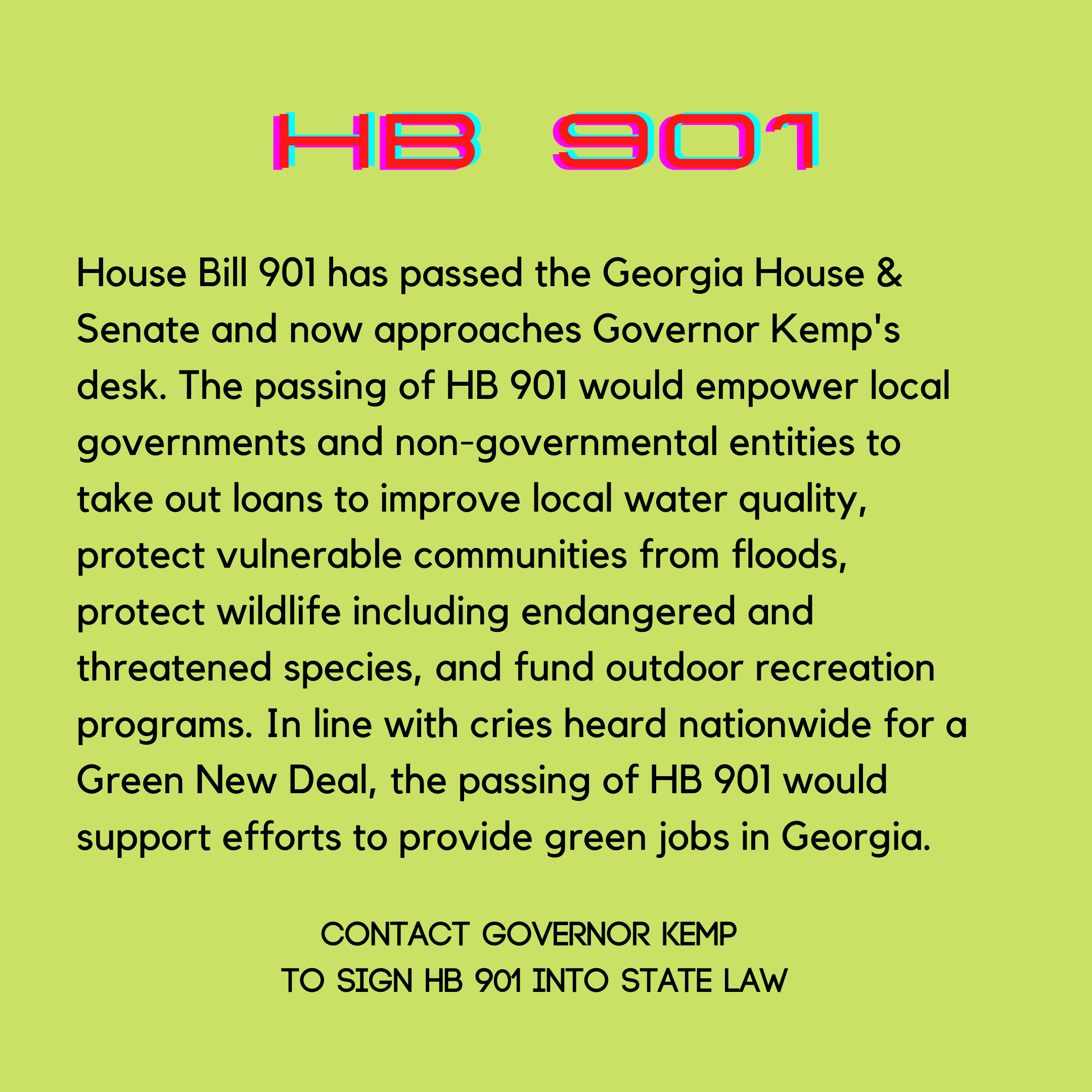
HB 901 has passed the Georgia House AND Senate and now approaches Governor Kemp’s desk. The passing of HB 901 would empower local governments and non-governmental entities to take out loans to improve local water quality, protect vulnerable communities from floods, protect wildlife including endangered and threatened species, and fund outdoor recreation programs. In line with cries heard nationwide for a Green New Deal, the passing of HB 901 would support efforts to create green jobs in Georgia.
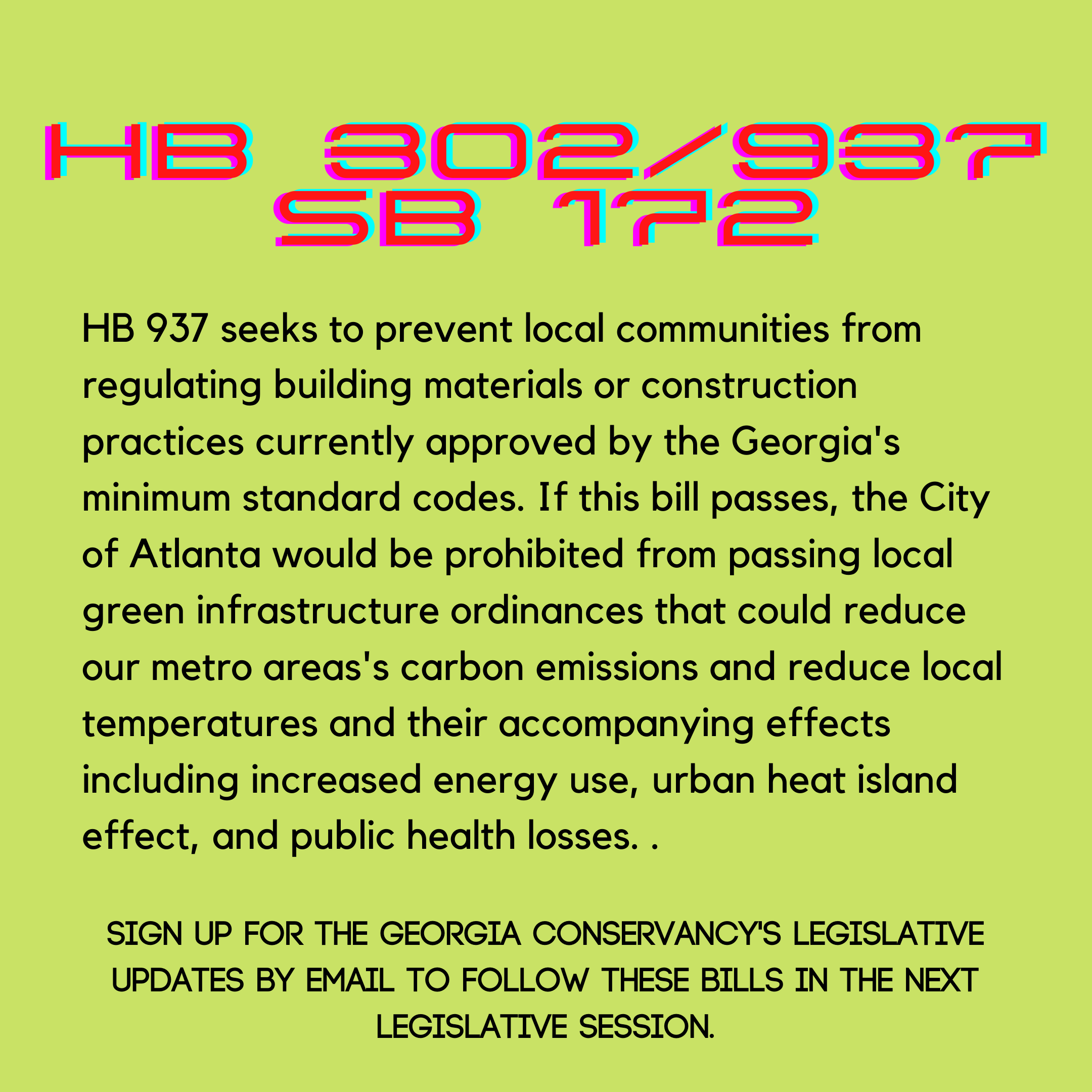
HB 302, 937, & SB 172 – Regulating the Zoning, Construction, and Design of Local Residential Properties
HB 937 seeks to prevent local communities from regulating building materials or construction practices currently approved in the state’s minimum standard codes. If this bill passed, the City of Atlanta would be prohibited from passing local green infrastructure ordinances that could reduce our metro areas’s carbon emissions and reduce local temperatures and their accompanying effects.
According to the Georgia Conservancy:
“These three bills have the potential to hinder, if not completely remove, innovation at the local level to address needs or leverage assets related to natural resources, housing, revitalization, or other land use conditions.”
All three bills have been deferred to the next legislative session.
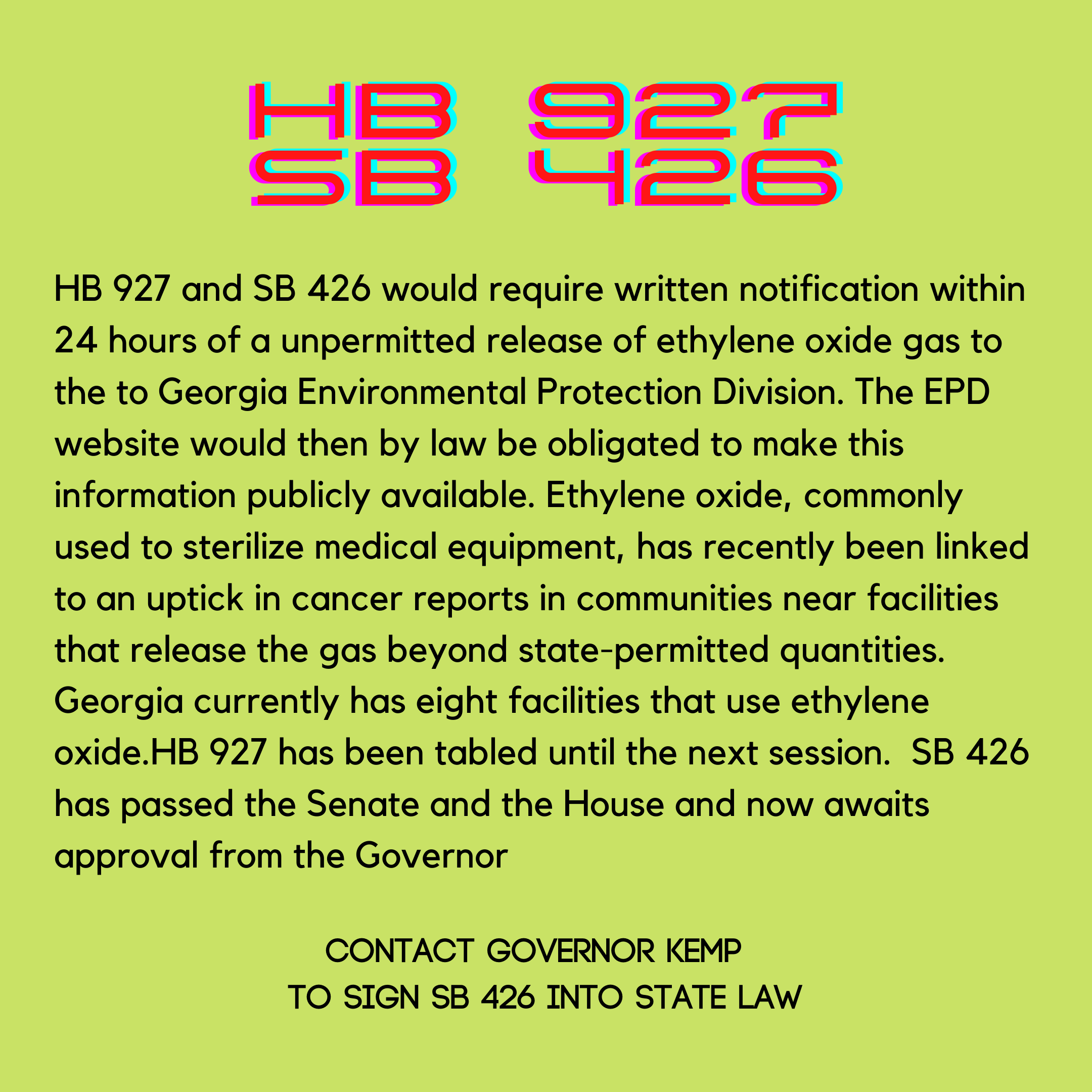
HB 927 and SB 426 holding facilities accountable for ethylene oxide use linked to recent uptick in cancer
HB 927 and SB 426 would require written notification within 24 hours of a unpermitted release of ethylene oxide gas to the to Georgia Environmental Protection Division. The EPD website would then by law be obligated to make this information publicly available. Ethylene oxide, used to sterilize medical equipment, has been linked to a recent uptick in cancer reports in communities near facilities that release the gas beyond quantities permitted by the state. Georgia currently has eight facilities that use ethylene oxide.
HB 927 has been tabled until the next session. SB 426 has passed the Senate and the House and now awaits approval from the Governor.
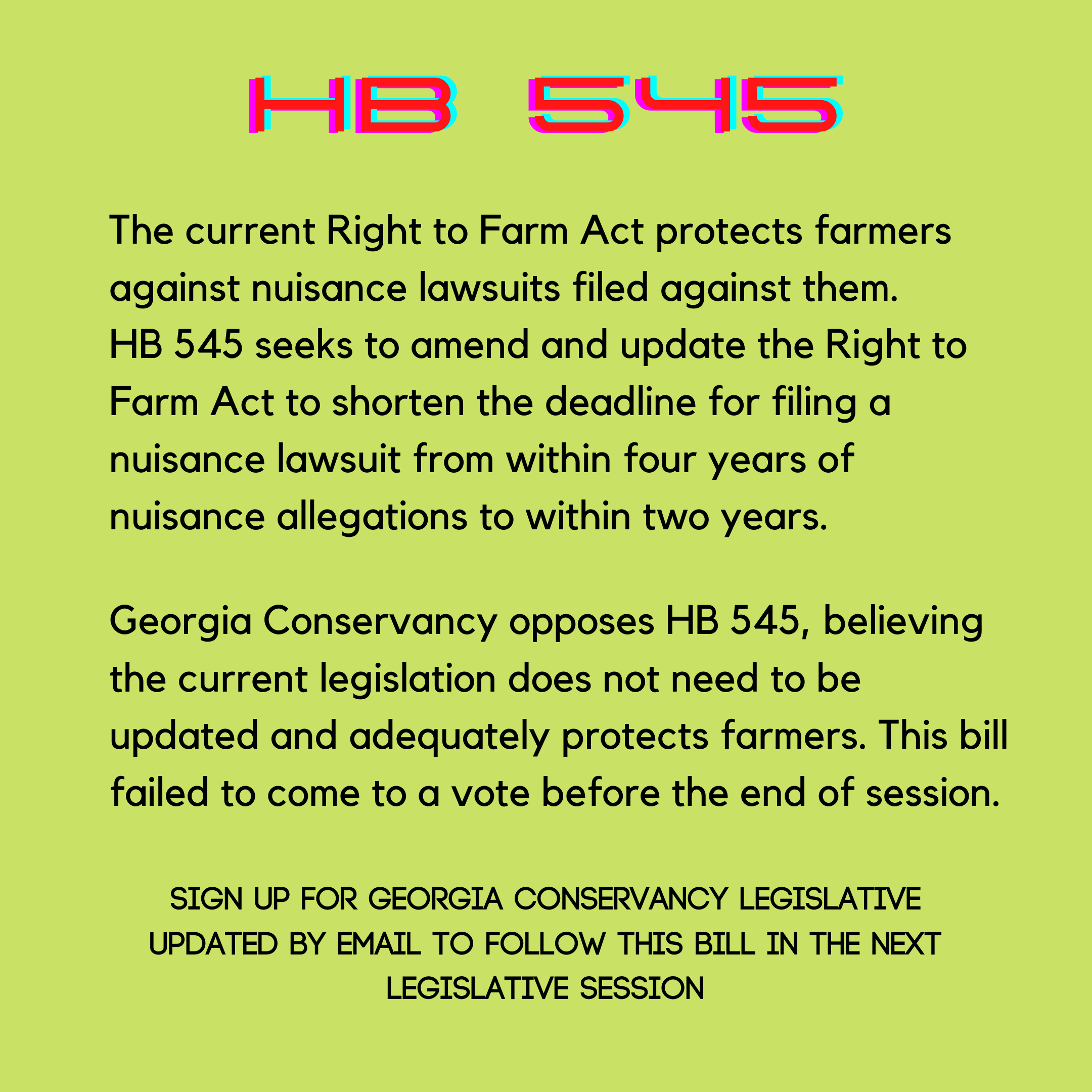
This bill proposes changes to the current Right to Farm Act. The Right to Farm Act protects farmers from nuisance lawsuits being filed against them, the current law states that such lawsuits must be filed within 4 years after said nuisance allegations come forward, but the new bill would change that to within 2 years.
Georgia Conservancy opposes this bill, believing that the current Right to Farm Act already successfully protects farmers from nuisance lawsuits. Other environmental concerns are that the new law would favor large livestock centers over small farmers and create loopholes for them to get away with land, air, and water pollutants released from their operations. The Georgia Farm Bureau, who supports this bill, responds to this by maintaining that polluting natural resources is illegal for any farm, and the Right to Farm Act only protects against nuisance lawsuits for farms operating legally. Any violation of current environmental standards or the other laws are still subject to prosecution under both the current Right to Farm Act and proposed changes. HB 545 has been deferred to the next legislative session.
In 2018, the Trump Administration opened Georgia’s coast to offshore drilling and oil exploration through seismic drilling. This resolution is a bi-partisan opposition to oppose this exploration for oil here in Georgia and instead maintain our coastal ecosystems and support coastal tourism and fishing industries. It is following the passing of a similar resolution in the House in 2019. The bill did not come up for a vote this session but Georgia Conservancy supports this bill and hopes to work with legislators to reintroduce it in the next session.
This bill would create and establish carbon credits that can be purchased by developers looking to offset their carbon footprint. This would be tracked through a carbon registry housed at the State Forestry Commission. The bill was amended to include the establishment of a Sustainable Building Material Carbon Sequestration Technical Advisory Committee to establish a baseline of what these carbon sequestering materials and practices would be and how they would be determined. Participation in the registry is voluntary for companies. HB 1015 has been deferred to the next legislative session.
After the recent whirlwind of police killings of victims George Floyd in Minneapolis, MO, Breonna Taylor in Louisville, KY, and Rayshard Brooks in Atlanta, GA, there has been an increasing call from the people to defund police departments that have been the perpetrators of brutality, violence, and murder against black people for centuries in the United States.
The people of Atlanta have mobilized numerous times to march and demonstrate in downtown Atlanta and beyond to defund the police, stop police brutality, end voter suppression, and dismantle the prison industrial complex. Especially considering that Rayshard Brooks was the 48th police shooting the Georgia Bureau of Investigation investigated in 2020 (Mainline Zine). In response to rising public sentiment to defund APD, Mayor Bottoms met with and Atlanta City Council June 15th to respond to public calls to revise the budget. Essentially, the amendment to defund APD by 50% was shot down and members of City Council -most vocally Antonio Brown of District 3 where Rayshard Brooks was killed by APD – have been calling on constituents to call into virtual City Council meetings to demand the City defund APD by 33% or 73 million to reimagine safety. In reimagining safety Brown is possibly subtly referencing a viral infographic that was circulating on social media:
Infographic from KnowYourMeme.Com
Since the 2021 Atlanta City Budget has remained unchanged, we at GreenATLiens thought you’d might like to know a few things that got defunded in order to increase the APD budget by over $12 million.
What did the City of Atlanta defund for 2021?
Please keep in mind this is not an exhaustive list. The full PDF of the 2021 Atlanta City Budget can be found here. GreenATLiens is also interested in examining how these particular instances of defunding not only harm the environment but also harm the black community, or in other words are concrete examples of systemic environmental racism.
Department of Public Works defunded from $51.7 million in 2020 to $0 in 2021. Public Works is responsible for maintaining infrastructure, so if there’s any broken bridges or crumbling historic buildings they’ll have to apply for a grant or rely on community donations to fund infrastructural renovations.
Built environment is an incredibly valuable aspect of sustainability. Preserving buildings and infrastructure helps us make things last for as long as possible and reduce the use of new resources. Built environment preservation helps reduce activity that contributes to climate change, essentially.
Defunding the Department of Public Works also disadvantages predominantly black neighborhoods in Atlanta, particularly Historic West End with historic buildings in need of renovation. The Atlanta Budget is essentially saying “You won’t get a cent from us, go have a fish fry to raise the funds cuz we ain’t helpin’.” The budget for Public Works in 2021 is literally $0! *Rubs eyes* Yep, still $0!
2. Department of Parks and Rec is being defunded by $1.6 million (2.4%) in 2021. Not only that but they’ll also lose 33 personnel (see below or budget page 70).
Parks as green spaces naturally are beneficial to the environment, specifically as urban wildlife habitats, carbon sequestration in the form of trees, water pollution reduction through plants that retain and prevent stormwater runoff that carries toxins into storm drains and ultimately our drinking water.
Parks are also highly important for maintaining public health. They provide a community green space to run, jog, play sports, or otherwise exercise, as well as improve one’s mental health through nature therapy and release of endorphins from physical activity and sun exposure. Defunding Parks and Rec means that communities lacking access to greenspaces are less likely to see any park development in the coming year. Wait, the budget says.
Screenshot of the Atlanta City Budget’s summary of personnel showing that APD will have an increase in personnel of 229, while Parks and Rec will lose 33 personnel, Watershed Management will lose 25, Human Resources will lose 9 and Department of Audit will lose 2.
3. The budget literally defunded justice. Atlanta’s Judicial Agencies got a 2.74% budget cut of $367K, so judges will be more overrun with cases than before. If you believe the Criminal Justice System and Prison Industrial Complex can be reformed, then defunding the courts that give Atlantans trials is a blow to justice and a disservice to the people.
Filling up prisons with black people for offenses white people get off easy for is another example of environmental racism. It keeps people out of the workforce and out of the voting pool to suppress black voters and keep black families economically destabilized without two members of household to contribute to household income and the work of running a household. Holding people in cages and forcing them to perform unpaid labor while leaving their families to fend for themselves is a modern form of slavery and oppression. A fair and non-corrupt justice system would end this continued disservice to Atlantans.
4. The Department of City Planning was defunded by $1.6 million (7.33%). Defunding City Planning means defunding walkability and bikability in Atlanta. Defunding City Planning is an example of systemic environmental racism and here’s why:
Poor urban mobility, meaning a poor ability to get around without full dependence on a car, is a systemic factor that makes it more challenging for low-income communities to get around to places like a job, the DMV, a poll location, or the grocery store. It’s essentially a way of keeping wealth in the communities that have wealth and denying low-income communities access to that wealth. Additionally, for those who do decide to walk or bike to access opportunities and needs, doing so poses a greater threat to one’s life than on, say, the cushy BeltLine or Freedom Park Trail.
Poor urban mobility reinforces poverty, car dependency, air pollution, and carbon emissions that contribute to climate change. Not to mention the effects of a car-dependent lifestyle on physical health. Car dependency also puts a financial burden on and further economically destabilizes low income households. This is why City Planning needs a budget increase and not a budget cut to improve urban mobility across all of Atlanta and particularly low income areas. Improved urban mobility and diminished car dependence reduces the city’s footprint and air pollution while also connecting communities to more opportunities. With reduced air pollution we’re likely to see less asthma-related hospitalizations and deaths, which disproportionately affect black and brown communities.
5. Water was defunded. The Water and Wastewater Revenue Fund is scheduled to be defunded in 2021 by $23 million (3.9%). The Department of Watershed Management is also scheduled to lose 25 personnel next year while APD adds on 229. Despite Atlanta’s innumerable water woes, Atlanta’s water received the second largest budget cut after the Department of Public Works. Perhaps they’ll pass the buck to non-profit organizations Chattahoochee Riverkeeper and Westside Water Alliance (WaWa) to keep our drinking water clean. Why spend government budget money on clean water when we can have these non-profit organizations apply for unreliable grant funding and rally their supporters to give out of the kindness of their hearts for our basic human right to clean water?
Cancerous toxins in our drinking water is an environmental health issue that quite literally, albeit slowly, kills the poor and disproportionately affects black and brown communities that have been systemically kept from accumulating wealth. Defunding water is defunding black lives, and defunding environmental health across the board for all Atlantans.
What can you do?
District 3 Council Member Antonio Brown is calling on all residents of Atlanta to:
“call in to every committee and full council meeting to demand we amend the budget and fund the resolution approved by council today. Reallocate $73M of police funds in order to reimagine public safety. We must stop the business of the city from moving forward until our demands are met.”
If you can’t attend the meeting due to work be sure to leave a voicemail write a message to your Councilmember and the general City Council email atlantacouncil@atlantaga.gov.
Sharing personally how defunding these various areas of the city budget to increase funding and personnel for APD affects you or a loved one will be the most impactful. Here are a few prompts to get you started:
Is there infrastructure near you that won’t get the attention it deserves as a result of cuts to Public Works?
Is there a lack of community greenspace where you live, or community greenspace that needs investment to be properly maintained? In that case why is Parks and Rec being defunded and scheduled for lay-offs when these greenspaces are of growing importance to the physical and mental health of our communities? If there’s a lack of greenspace where you live, how far would one have to walk to the nearest greenspace? Is it a safe walking distance for children?
Have you or a family member been incarcerated? How did that affect your family economically, emotionally? Do you think defunding the Atlanta’s judicial agencies is in the interest of justice for the people of Atlanta?
Do you walk, bike, or take public transit for transportation? Or would you like to? Tell City Council that cuts to City Planning hurts urban mobility in Atlanta and in turn dampens economic opportunity, reinforces income inequality, and increases car dependency that’s shown to be so detrimental to environmental health as well as public health.
Do you drink water? Would you like Atlanta’s water to be safe to drink for all Atlantans? Don’t you think instead of defunding the Department of Watershed by $23 million (meanwhile increasing APD’s budget by over $12 million) we should be increasing investment in clean water for all?
That’s all for now. Please feel free to add your comments, we’d love to hear your thoughts. Stay green, ATLiens!
March on Georgia this Monday, 9:00AM at the Richard Russel Federal Buildong 75 Spring St SW. Don’t forget your masks, signs, and energy!
There is no sustainability in Georgia’s future without repealing citizen’s attest, criminal legal reform, restoring voting rights, and ending police brutality.
Removing invasive plant species from our own yards is an actionable way we can all help reverse the effects of climate change. As it turns out, our insect populations are being decimated by invasive plants, which out-compete native plants and create habitat “dead-zones”. Professor of Entomology and acclaimed author Bringing Nature Home, Doug Tallamy sums up why this is important: “Life as we know of it depends on insects,” Tallamy tell us. “If you take those insects away, nasty things will happen.” This is because insects are one of the only organisms on the planet that eat the food plants make from the sun with photosynthesis (I know! It’s like magic!!), and make it readily available to the rest of the food chain, including us. One native oak tree can support up to 280 different species of insect. Take into account that 97% of our terrestrial songbirds raise their young on insects alone, and we start to see how this snowballs very quickly.
Remember, without pollinators we also don’t have fruits and veg. And for you carnivores out there, without birds and rodents, we don’t have grasslands or forests to support sustainable meat production.
So, you want to help! That’s great! But looking at your yard and knowing where to start can be intimidating. Take a deep breath and remember that restoration is a process. You’re not going to lose that quarantine-15 you gained over the past 3 months overnight, and your yard won’t get “fixed” from years of neglect in one go. That’s why we always start with the most valuable ecological commodity in any ecosystem when we’re removing invasive plants: the TREES!
With that said, meet the first invasive plant in a long list of Atlanta’s most notorious invasive plants, English ivy! The biggest natural resource Atlanta has is its urban forest; its trees. The biggest threat to trees in the Atlanta Metro area is English ivy, or Hedera helix if you want to sound smart. English ivy strains and weakens the infrastructural integrity of the tree by acting as a dead weight and creating a wind-sail effect along the trunk. When the vines reach the top of the tree, they will drop down runners which anchor and eventually pull down the whole tree like a winch.
Removing English ivy seems easy, right? It’s just cutting some vines, right? Wrong! Severing the connections between the vines infesting a tree is a temporary fix. If you want your trees to breathe easy and get healthy again, those vines have to be pulled back and the roots removed. Keeping ivy out and away from your trees will inhibit it from reproducing and make it easier to remove from the ground layer over time.
Step 1: First thing to do is get prepared: wear closed toed shoes, pants and long sleeves because English ivy really likes to hang out with poison ivy! You will need a cutting tool, a digging tool, and a prying tool. I like my small loppers, soil knife, and machete but a handsaw, handpick, and pry-bar will work just as well.
Step 2: Now, cut the vines around the trunk of the tree. You want to cut them 6”-1’ off the ground, or where at the top of the tree’s root flare in order to have enough leverage to pull them off/out.
Step 3: Cut the vines connecting these sections and then begin to work your prying tool under the section to loosen them. The vines fuse together on the tree trunk, creating a living suit-of-armor. Like a suit of armor has plates, the ivy can be broken into sections.
Step 4: Pull back the vines along the trunk, being careful not to damage the bark. Like when you play with a rope as a kid and make a transverse wave that travels along it, use the vines’ own momentum in a snapping motion to pull them off if they are loose enough. Pull out, never down.
Step 5: Cut and roll back the vines, creating a circular berm with a 2’ radius around the base of the tree. Pull and dig out roots as you go. If there are roots that are too big to be dug out, cut them, leaving at least 1’ of the vine behind so it can be poisoned in the future if need be.
Step 6: Take the sections you’ve removed from the tree trunk and lay them leaf side down over your berm. This will help suppress future growth.
Step 7: Replace leaf litter from the site in your now cleaned 2’ “circa-base”. Step back, admire, brag to your friends.
Step 8: Do it again 🙂
This may seem like a lot, but don’t get discouraged – it’s all about technique, baby. At EcoLogic, we’ve come across trees with infestations over 50 years old. It’s pretty remarkable that in an afternoon, we can free a 150 year old oak tree that can support over 280 insect species, which support hundreds of vertebrates like us.
Stay tuned as we make our way through the list of Atlanta’s most notorious invasive plants and learn how to DESTROY THEM (or manage them in an ecologically friendly and sustainable manner).
About the Author
Meet Tanya “Tea” Povolny, expert on native and invasive plants and founder of EcoLogic, an invasive plant removal service. You can follow her on Instagram at @ecologic.atlanta. You can read more about Tanya here and on her company’s website Eco-Logic ATL.
We don’t often think of manmade structures as part of the environment, and yet they are. Humans, also not often thought of as part of the environment, dwell in these structures. Many others dwell without them, something humans have termed as “homelessness” -a loss of human habitat accepted by too many of the fortunate as resulting from the moral failings of the homeless. Humans and housing are a part of our environment, whether it’s accepted or not.
This week the Georgia Conservancy hosted a panel on “The Economics of Housing in Georgia” on their weekly Facebook Live this past Tuesday May 19th at 12 noon. You can watch the 1 hour live here. If the privilege of time escapes you, please see the GreenATLiens summary below.
The Economic Impact of Housing in Georgia
This panel consisted of three presentations, one by the Georgia Conservancy, one by Bleakly Advisory Group, and one by Electric Cities of Georgia. A Q&A followed the presentations to discuss housing development issues in Georgia further.
The majority of Georgians’ income does not match the rising costs of housing. The difference between an affordable home for the workforce and the average home price is a staggering $159K. In the Atlanta area 30-40% of households are considered “cost burdened” or spend a third or more of their income on housing. Georgia will grow by 4 million people by 2040. Taking into consideration high home prices vs. low wages, cost burdened households, and population growth, raising the state minimum wage and lowering the cost of housing will be crucial to Georgia’s future resilience.
Takeaways: We’re experiencing dramatic demographic and generational changes that directly affects housing in Georgia. Household size has been shrinking steadily over the decades, and our housing supply is primarily built for the American nuclear family that is no longer the norm. Younger generations prefer walkability and work from home options, which makes housing and the amenities surrounding housing more important. This market is willing to pay more to live in “walkable” areas. Investing in downtown areas has been shown to improve cities’ economic growth even more than large shopping malls.
Takeaways: It’s important for cities to develop a well balanced tax base that’s a mix of housing, industries, retail, as well as investing in their downtown and quality of life enhancement (such as parks). Doing so will provide a more stable tax base for cities to fund programs that enhance the lives of residents. Holistic economic development required hard and soft infrastructure (see slide 5 for factors cities can control). Housing diversity is especially important given the demographic changes we’ve been experiencing over the decades of smaller households as well as expected economic hardship as a result of COVID-19 that will make more affordable housing more heavily demanded. Mixed use and walkability will be increasingly important going forward to meet the demand of residents.
What is example of a community or a project that you’d like to lift up for having done really great housing projects that support local economic development in a thoughtful way?
Geoff: Two that I can think of that are not necessarily Atlanta-centric are West Point and Rome, Georgia. West Point has a great historic core. Buildings had been sitting there for decades without being fully used and through concentrated efforts they now have 30 or 40 new housing units above retail in their downtown core. In Rome, Georgia they’ve done a lot on the affordable housing side and focused on downtown housing that I think can serve as a model throughout the state. (main emphasis: mixed use, focus on inner city center, walkability, affordability)
Mill: Thomasville, Georgia brought in a lot of progressive housing types into their urban development. Providing quality affordable housing within a quarter mile from downtown it’d been just a great project overall that other rural communities can aspire to.
Katherine: I’d like to give a nod to Georgia’s Mill villages and Mill neighborhoods. These are tremendous opportunities for fresh eyes. They are walkable in and among themselves. Mills can lend themselves as loft opportunities and we see this again and again across the state.
What are some ways that you can promote affordability on top of just promoting good housing policy and housing diversity.
Geoff: I’m a big fan of land banking. Granted cities and counties already have a lot on their plate trying to figure out this year’s and next year’s budget. But in a perfect world cities and counties are out there looking for ways to bank land for housing and using resources and federal government grants to buy land or even buy buy units in their historical downtown. If it’s under public control, especially if you’re controlling the housing units, you have the ability to control how much a person is going to pay for those housing units. Through downtown development authorities and other avenues land banking can then be aggressive in getting that land developed to provide housing. Once the city or the public sector controls the dirt underneath there’s a potential opportunity to impact how much a resident is going to pay for that. In doing so you have the ability to really impact what kind and what price of units are being built.
Mill: I’d completely second Geoff on that one as far as a really effective strategy and one that honestly we’ve always utilized at ECG. It’s an extremely effective strategy and one I think that is going to work for those communities that are able to do it. From a bigger picture what most communities may be able to allocate some of their resources towards are really identifying redevelopment opportunities in their communities. This should be a priority for every city across the state if they can is really to identify where these redevelopment opportunities are and take a strong look at your housing.
In addition encourage specific areas that allow the types of housing that we know can be more affordable such as duplexes and fourplexes and things of that nature that for most municipalities of Georgia are not allowed by regulations and ordinances. What I’ve seen in other communities across the country is places where they’ve established areas in their downtown or within certain neighborhoods that have been historically low income allowing that type of development to encourage more affordable housing in those spaces.
Do you have any experience in land bank resources being put to use through community land trust?
Geoff: The work Amanda Rhine is doing at the Atlanta Land Bank comes to mind. I know Brunswick has set up a community land trust recently. I would look into what Amanda has been doing here in Atlanta.
Mill: Amanda’s work is a great case study. Albany, GA has one. Athens land trust could probably be a good resource as well.
How has the pandemic affected housing?
Geoff: The other shoe hasn’t dropped yet on housing and the economy. Housing prices and rental payments have held up pretty well so far. If you just look at the numbers through the beginning of May you would hardly know we’re in the middle of a a pandemic with 15% unemployment. It just seems unreasonable to think that’s always going to be the case over the next 12-18 months. So there’s a lot that remains to be seen. It will impact housing no doubt.
The demographics I talked about, they’re not going to change. We’re still going to have small households and a mismatch between our household makeup and our housing stock. That’s not going to change with COVID. We’re still going to have a tremendous amount of smaller households looking for smaller and different housing. What that looks like at the “end” of all of this I think we’re still working through that and waiting to see what happens when that other shoes drops on the economic side of housing. It’s a bit early to tell but again the demographics are going to drive the future of housing to a large degree. So, we’ll see.
Mill: Geoff you’re completely right, the demographics are always in the driver’s seat with respect to this so COVID’s not really going to change a lot of that. We’re probably going to see more renters I would imagine coming out of this and just in general communities that kind of have a monoculture of a housing product. When I got ot a lot of my communities there’s a whole lot of single family. If there’s any sort of struggle coming out of this with respect to foreclosures and things of that nature I think those communities with fewer diversity of housing types are going to take a hit. There’s a lot that remains to be seen. If anything [COVID] could potentially be an impetus to accelerate some stuff around retail evolution which we’ve already been seeing but also with housing. The biggest challenge I see is from the government regulation side to allow some of these types of housing. That for me is one of the biggest challenges moving forward and I think COVID-19 could be an impetus to really push that discussion to the forefront. Whether it’s something around your downtown built environment or just your housing a lot of people are going to come out of this worse off than when they went into it and so a lot of cities will be looking at this. andsaying what can we do to help and there’s a lot we can do on the housing front.
Geoff: You’re probably hearing and will continue to hear a lot about resiliency. The colloquial evolution of resiliency is “don’t put all your eggs in one basket.” If something fails and that’s where all your eggs are then we’re in trouble, so disperse the risk I guess you may say. Thinking about that in terms of housing is essential coming out of this. The more resilient cities, towns, and counties that have a wide variety of housing means that you’ve got a variety of housing ready to go no matter what the case whether we’re in a pandemic or not your housing stock is ready to accept the future. But if it’s all in one basket and the future heads in a different direction you’re left behind. So that’s just something to think about generally whether it’s retail, housing, your budget, whatever it may be is to think about that resiliency and how you can disperse the risk when things take a turn for the worst.
This was an extremely informative hour-long panel by the GA Conservancy, and the information shared here will be highly valuable when joining local groups such as the Housing Justice League to advocate for affordable housing.
A few action items
Sign the Beltline For All petition by the Housing Justice League (HJL) to support efforts for affordable housing around the Atlanta Beltline.
When astronomers gaze into their telescopes to search the crevices of the universe for habitable planets, they are hoping to find one thing: water. Water is one of the most important elements necessary to sustain life. We use it for everything. Try to name at least one essential activity you do every day that doesn’t require water in some shape or form. Pretty difficult, right? Because water is an integral part of our lives, local governments are constantly developing strategies to sustainably manage and conserve it. This fact is especially true for the city of Atlanta. Did you know that the city’s emergency water reserve has only enough for three days? How is this even possible, you ask? What are city officials doing to address this? To answer these questions, we need to first talk a little bit about Georgia’s watersheds.
Watersheds. What is a watershed? A watershed is an area of land that drains all the water from rainfall and snowmelt into a common body of water. If this definition isn’t quite clear, think of an open upside-down umbrella. The rain falls on the surface of the inside of the umbrella, slides down the ribs to the center near the handle, and creates a pool of water. In this case, the upside-down umbrella acts like a watershed and collects the water into a central place. Additionally, like the ribs of an umbrella, watersheds are composed of networks of smaller waterways like creeks, rivers, or lakes that ultimately drain into larger bodies of water. They also vary in size ranging from small puddles to huge tributaries that span several states. Georgia has fourteen major watersheds. However, for our purposes, we will discuss two: the Chattahoochee and Coosa.
(Photo Source: University of Central Florida)
Now, that we’ve learned about watersheds. It’s time to get back to Atlanta’s problem. When I think about Atlanta’s water dilemma, it reminds me of baseball. Baseball is a game of strikes and home runs. Let’s first examine Atlanta’s strikes by identifying the conditions that contribute to the city’s limited water supply. The first strike is its location. The metropolitan area isn’t in the most water rich area. In fact, almost all of the metro-Atlanta region’s water supply is from surface water, while only a small percentage comes from groundwater. Therefore, the region relies heavily on the reservoirs (A reservoir is a place where water is stored.) Lake Allatoona and Lake Lanier in the Coosa and Chattahoochee river basins, respectively. Eighty-seven percent of city’s water supply is from these reservoirs, primarily Lake Lanier.
Additionally, these reservoirs are located near the source of the river basins or headwaters and they travel down and across the state borders of Alabama and Florida. The river basins are Alabama-Coosa-Tallapoosa (ACT) and Apalachicola-Chattahoochee-Flint (AFC). All three states share the AFC river basin, while only Georgia and Alabama share the ACT river basin. Over the years, there has been a lot of debate, conflict, and litigation around how water in the river basins should be allocated and used. The clash between these states is commonly known as the “Tri-State Water Wars.” Technically, each state has water rights to the basins. However, Atlanta must limit the amount it takes from the reservoirs to avoid significantly decreasing the water flow in Alabama and Florida. STRIIIKE ONE!
(Photo Source: Atlanta Regional Commission)
Make sure to come back for my next post where I’ll talk about Atlanta’s other two strikes and some of its home runs. Have something to add or thoughts of your own on ATL’s water supply? Leave a comment below or on our Facebook or Instagram page! See ya next time!
About the Author
Sydney-Alyce is GreenATLiens’ Water ATLien and resident ecologist. She’s passionate about approaching problems through an ecological and sustainable framework. You can follow her on Instagram at @thesoulleaf. The full bio of Sydney-Alyce and all GreenATLiens content writers will be coming soon!
Can ATLiens do better than a 20-25% recycling contamination rate? Here’s how you can fix your recycling fails & stop wish-cycling.
We ATLiens are fortunate to live in a city that has a strong recycling program. But, if you’re like me, sometimes it’s tempting to toss an item into the blue bin hoping that it’s recyclable, but not really knowing for sure. This is called “wish-cycling” and leads to higher recycling costs, contamination and inefficiencies. So this week, we spoke with the city to find out how ATLiens can do better when it comes to recycling. Here’s some of what we learned.
Let’s look at the top 2 of the 7 most common recycling mistakes residents make:
#1 Bagging Recyclables
Atlanta’s recycling program is a single-stream process where we throw all our recyclables in one bin, which means bagging up your recyclables is a no. Bags muck up the process and get tangled in recycling equipment, adding to facility maintenance costs. Throw your recyclables in the blue bins loose ATLiens! It’s surprising that this is the #1 violation, but it is.
#2 Including Plastic bags, Wraps and Film
Plastic bags, wraps and film are recyclable, but not in our curbside bins. These materials cause jams in the recycling equipment. To recycle these items right, they need to be returned to designated plastic film recycling drop-offs at stores or reused.
So what goes in the blue bin? Think clean, loose and dry:
Metal – Aluminum and Steel Cans
Paper – Cartons, Mixed Paper, Newspaper and Magazines
Plastic – Bottles and Containers
Want to know more about what’s accepted curbside? Go to www.atlanta.gov/recycling where you can use the “Waste Wizard” to look up various items. It’s kind of your secret weapon that tells you if the item can go in the blue bin, and offers advice if not. The city states “Recycling is local and can change from one community to the next. You may have moved from Smyrna to the City of Atlanta and notice slight changes. That is how local recycling can be. It is also changing and evolving… as technology to process that material adapts.”
Interview transcript between GreenATLiens Zero Waste correspondent Karen Green, Keep Atlanta Beautiful Commission Community Affairs Manager Moses Tejuoso, and Keep Atlanta Beautiful Commission Executive Director of Kanika Greenlee:
What are the 5 – 10 most common “recycling fails” you see residents make when recycling curbside?
Recycling can be simple. We want our 98,000 households to fill up their curbside recycling cart with the following items clean, loose and dry: Glass (bottles and jars*), metal (aluminum and steel cans), paper (cartons, mixed paper, newspaper, magazines), and plastic bottles and containers.
The most common “recycling fails” from the Feet on the Street cart tagging program have been people bagging recyclables and putting plastic bags/wrap/film in the cart. Though recyclable, these items are not accepted in your curbside cart. They should be returned to retailers or re-used. All in all the top recycling fails we see are:
Bagged Recyclables
Plastic Bags, Wrap or Film
Food or Liquid
Scrap Metal, Wood or Furniture
Clothes or Linen
Tanglers, Cords, Hoses or Chains
Yard Trimmings
The City of Atlanta’s Feet on the Street recycling contamination brigade in action! The program is currently suspended during the COVID-19 crisis.
We’ve all heard that contamination in our blue bins can ruin a truckload of recyclables. Can you tell us how this works? At what level would an entire truckload get sent to the landfill?
The decision to reject contaminated loads is made by staff at the Material Recovery Facility (MRF) and not by the City. Individual truckloads are unloaded and visually inspected to determine the level of contamination while loading equipment places materials onto conveyor belts for manual/automated sorting. Trash and non-recyclable materials travel through the MRF until they are eventually discarded. A load would be considered clean with only a single greasy pizza box. Whereas, the City would receive feedback regarding bagged recyclables, plastic bags, food waste/liquids to provide targeted education to the servicing route. Our contamination rate is approximately 20-25%. (National Average – 17.67%*). Source: The Recycling Partnership 2020 State of Curbside Recycling Report.
Our contamination rate is approximately 20-25%. (National Average – 17.67%*).
Given the COVID-19 situation, residents may have specialty recyclable items piling up as CHaRM is temporarily closed. Do you have any suggestions for places that may be still open accepting items?
Our department supports CHaRM operations and understands the inconvenience caused by it’s temporary closure. We too have had to make operation changes for the safety of our employees. For instance, we’re no longer collecting items that don’t fit in curbside carts during our regular collections. Many donation centers have ceased operations for material handling concerns. Visit www.atlantaga.gov/solidwaste for updates related to COVID-19 operation changes which includes CHaRM.
Is there anything you would recommend to all Atlantans, for example learning more about the Feet on the Street campaign, encouraging people to download the ATL311 app and use the Waste Wizard, etc.?
Yes, please visit the www.atlantaga.gov/recycling webpage to learn about the Feet on the Street recycling contamination program (currently suspended). There you can find the following:
Is there anything else you would like residents to know?
Recycling is local and can change from one community to the next. You may have moved from Smyrna to the City of Atlanta and notice slight changes. That is how local recycling can be. It is also changing and evolving as technology to process that material adapts.
About the Author
Karen Green, Zero Waste GreenATLien
Karen Green is GreenATLiens’ zero waste and circular economy correspondent. She is the creator behind Instagram’s @yourrecyclingteam account. The full bio of Karen and all GreenATLiens content writers will be coming soon!
Bright and early on Friday, May 1, 2020 at 7:30am 158 or so people gathered in front of their computers to attend Southface’s first virtual Sustainable Atlanta Roundtable. This month’s roundtable was dedicated to a heated topic in Metro Atlanta – development without displacement. As the Atlanta Beltline and other developments have caused property values to rise , affordable housing has become a central issue for mitigating the economic and geographic displacement of Atlanta residents (1, 2, 3). Panelists Nathaniel Smith of the Partnership for Southern Equity, Donell Woodson of the Lupton Center, and Alex Trachtenburg of Southface joined moderator Michael Halicki of Park Pride for a discussion on equitable development in Atlanta.
But first, what does equitable development have to do with sustainability? If we define sustainability as maintaining an ecological balance by avoiding the depletion of natural resources, there are many linkages between environmental sustainability and equitable urban development. The first is urban sprawl. Equitable development can help prevent displacement of low-income residents and in turn prevent further urban sprawl. Increased urban sprawl presupposes car dependence, which leads to a number of environmental issues. Adverse environmental effects of urban sprawl include:
Carbon emissions, known to increase atmospheric temperatures, otherwise known as climate change or global warming (4)
Air pollution, directly harming plants and wildlife as well as humans -think increased cases of asthma and asthma hospitalizations, or the less obvious effect of increased infant mortality rates (5, 6, 7, 8)
Noise pollution, known to adversely affect wildlife as well as humans (9, 10)
Adverse public health outcomes, such as increased rates of obesity, diabetes, and cardiovascular disease associated with a car dependent lifestyle (11, 12, 13). These adverse public outcomes make our healthcare systems more expensive to maintain, which in turn limits available funding for allocation to sustainable development, cyclically reinforcing environmental injustice.
This is just one linkage between equitable development and sustainable development. There are others. Now that it is clear how equitable development is connected to sustainability, captured here for you are the presentations from Southface’s Sustainable Atlanta Roundtable on Development without Displacement:
Q. Nathaniel: Is there a gold standard for development without displacement an if so who’s doing it right? What is the first step or the top policy priority locally and statewide in GA?
A. (Paraphrased) There is no gold standard. Solutions in NY will be different from solutions in the Rust Belt because the communities are structured differently. The 14th St. Bridge Project in Atlanta has been a very encouraging development. Efforts around Climate and Energy with the Equitable & Renewable Cities Initiative being carried out with PSE and the Mayor’s Office of Sustainability is helping build racial equity through sustainable development. We have to undo and redesign the delivery system for affordable housing and development in cities and in regions. Right now the delivery system is driven by profit, is imbalanced, is not driven by the voices of community -and values success through production rather than creating whole, sustained communities. Focus more on people over production and profit is the way forward.
(Two more questions, uncaptured. If you have notes on these additional questions in the Q&A session please send your notes to greenatliens@gmail.com to have them added to this post)
Q. 83.2% of those in the hospital for COVID-19 are black. Recent New York Times article As Georgia Reopens, Virus Study Shows Black Residents May Bear Brunt raised legitimate questions of structural inequality and structural racism in public health. What efforts will you make to turn “lemons into lemonade” and return not to the old normal but to move forward into a more equitable and inclusive now?
A.
Nathaniel: I hope COVID-19 has helped the world understand that no matter how hard you try to avoid it, structural racism will continue to be the great sin of america. If we don’t find ways to undo that sin we will all suffer. It’s not just about COVID-19, it’s also about the 2008 foreclosure crisis, it’s about us sitting in traffic because structural racism won’t allow MARTA to expand into commuter communities. We must continue to push our white allies and advocates to be more bold and courageous in confronting structural racism and inequality and speaking truth to power. Staying on the sidelines makes us complicit. That is the space I am currently trying to create.
Alex: COVID-19 has exposed unjust systems across the globe. Hopefully people are seeing that we’re all inextricably linked. We can all be affected, we can all lose our jobs and our quality of life. How do we look at development in a way that uplifts everyone, that promotes intergenerational wealth within marginalized communities? Hopefully this pandemic will prompt more policy conversations at the local, state, and national level to achieve that.
Donell: Two thoughts: Dr. King’s thought of beloved community, which is not just theoretical but actionable. Let’s all think about place, our geographic location. Name what we love about it. Then start from that point to work our way back to the issues so that we hold our intention – that which we love in our place – and what needs to be righted. Place is where we find common unity or community. Orienting ourselves around place is the launching pad for building community.
What else do you think can be done to achieve more equitable, sustainable development in Atlanta? Let us know in the comments on this blog or our Facebook and Instagram!








 Green ATLiens