Earth Overshoot Day (EOD) is the date in any given year reflecting when human consumption of Earth’s natural resources has depleted more than the Earth can regenerate in a year.
In 2020 Earth Overshoot Day falls on August 22, more than 3 weeks later than in 2019 due to COVID-19 lockdowns around the world.
EOD is calculated by the Global Footprint Network by dividing the world’s biocapacity (the amount of natural resources generated by Earth that year) by the world’s ecological footprint (humanity’s consumption of Earth’s natural resources that year) and multiplying by the number of days in the year.
The footprint calculator will tell you based on your responses when in the year personal “Overshoot Day” falls – meaning, when would Earth Overshoot Day fall if everyone lived like you? The author of this post got Nov 21 as her personal “overshoot” day. Let us know how you did!
After you’ve taken the quiz, think of an action or two you can realistically take to reduce our collective ecological impact. GreenATLiens recommend applying pressure on our elected officials to transition to 100% renewable energy! Incorporating more plant-based meals into one’s diet or adding a car-free day to your week are great morale-boosting individual actions to take, but remember this is bigger than any individual and we need systemic change to solve systemic issues!
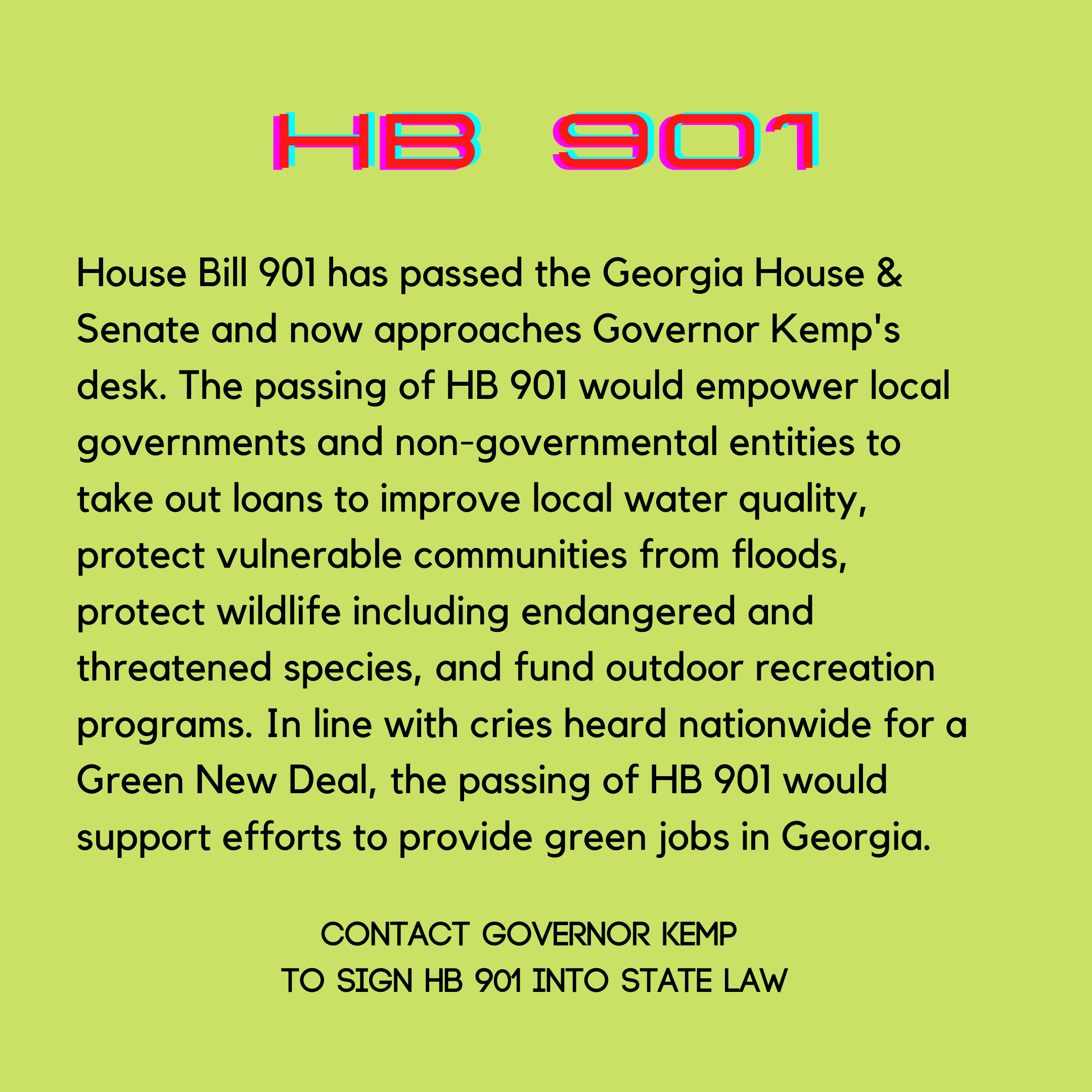
HB 901 has passed the Georgia House AND Senate and now approaches Governor Kemp’s desk. The passing of HB 901 would empower local governments and non-governmental entities to take out loans to improve local water quality, protect vulnerable communities from floods, protect wildlife including endangered and threatened species, and fund outdoor recreation programs. In line with cries heard nationwide for a Green New Deal, the passing of HB 901 would support efforts to create green jobs in Georgia.
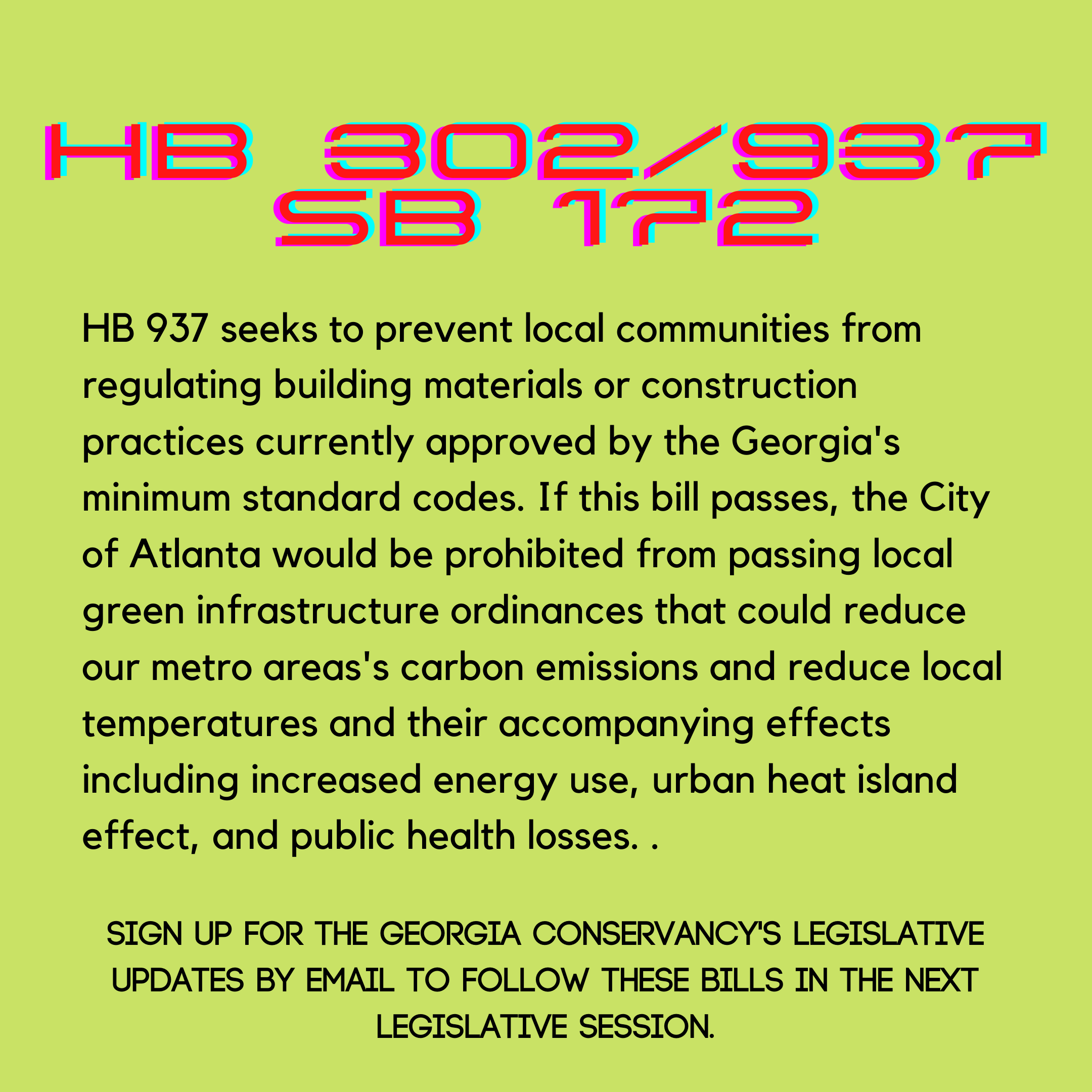
HB 302, 937, & SB 172 – Regulating the Zoning, Construction, and Design of Local Residential Properties
HB 937 seeks to prevent local communities from regulating building materials or construction practices currently approved in the state’s minimum standard codes. If this bill passed, the City of Atlanta would be prohibited from passing local green infrastructure ordinances that could reduce our metro areas’s carbon emissions and reduce local temperatures and their accompanying effects.
According to the Georgia Conservancy:
“These three bills have the potential to hinder, if not completely remove, innovation at the local level to address needs or leverage assets related to natural resources, housing, revitalization, or other land use conditions.”
All three bills have been deferred to the next legislative session.
HB 927 and SB 426 holding facilities accountable for ethylene oxide use linked to recent uptick in cancer
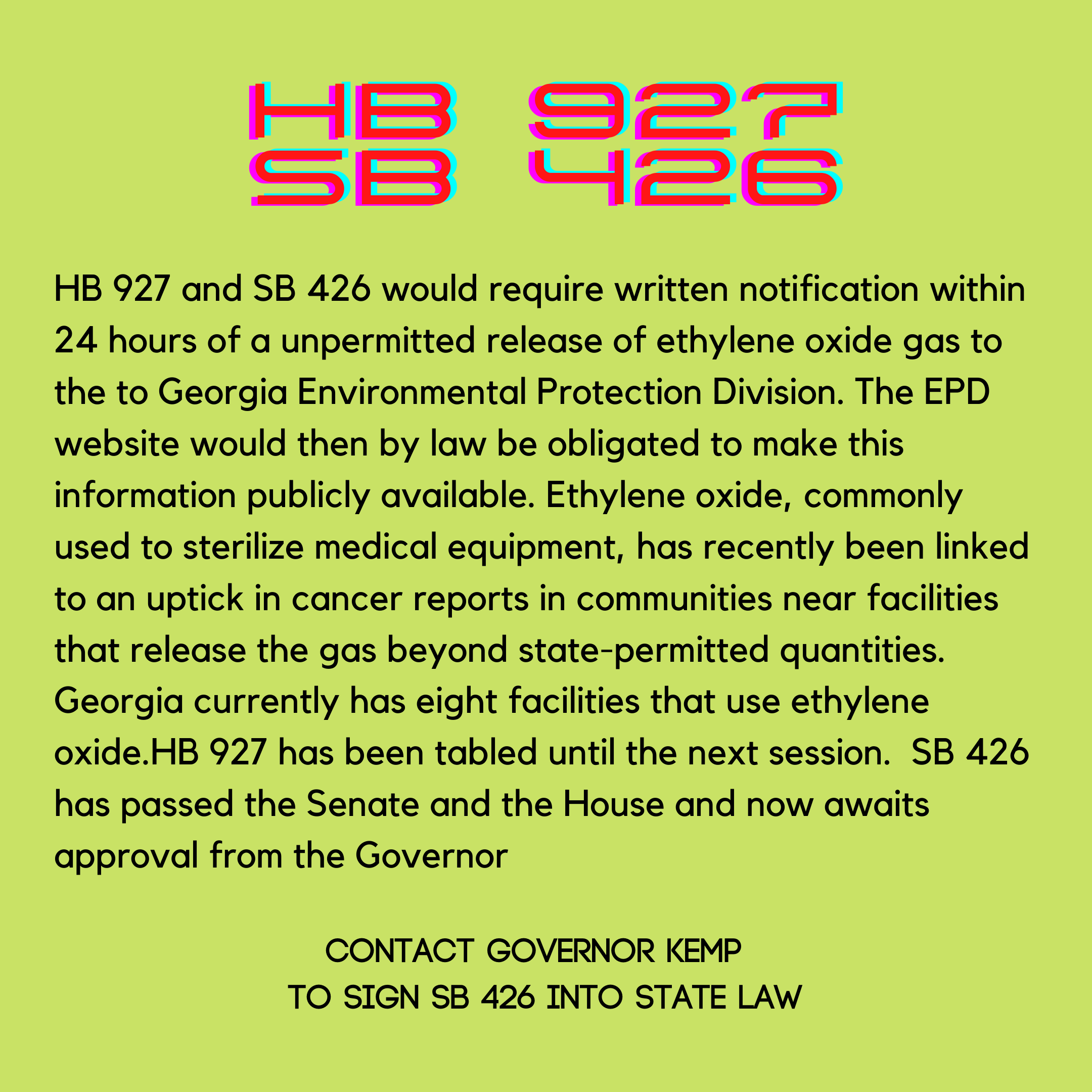
HB 927 and SB 426 would require written notification within 24 hours of a unpermitted release of ethylene oxide gas to the to Georgia Environmental Protection Division. The EPD website would then by law be obligated to make this information publicly available. Ethylene oxide, used to sterilize medical equipment, has been linked to a recent uptick in cancer reports in communities near facilities that release the gas beyond quantities permitted by the state. Georgia currently has eight facilities that use ethylene oxide.
HB 927 has been tabled until the next session. SB 426 has passed the Senate and the House and now awaits approval from the Governor.
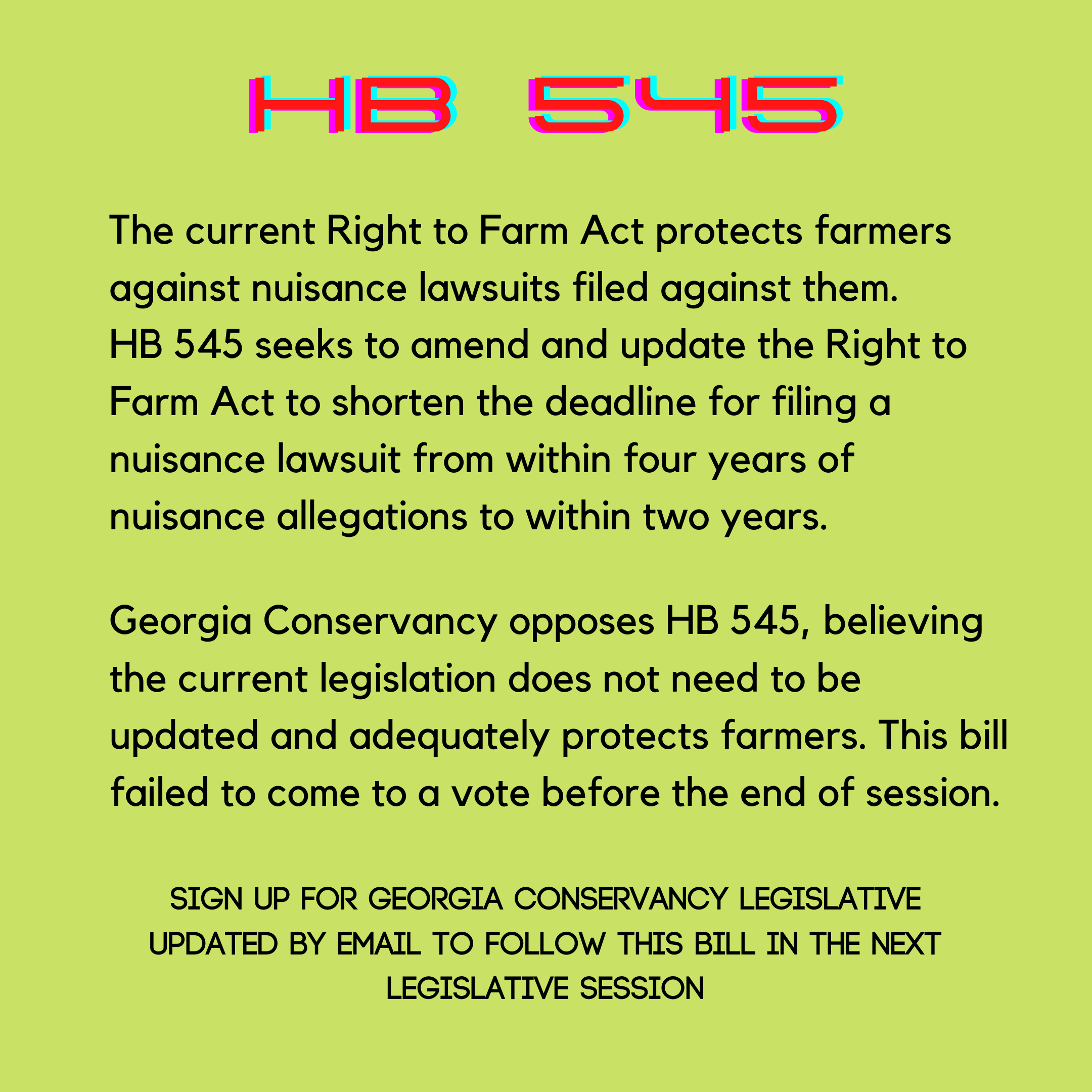
This bill proposes changes to the current Right to Farm Act. The Right to Farm Act protects farmers from nuisance lawsuits being filed against them, the current law states that such lawsuits must be filed within 4 years after said nuisance allegations come forward, but the new bill would change that to within 2 years.
Georgia Conservancy opposes this bill, believing that the current Right to Farm Act already successfully protects farmers from nuisance lawsuits. Other environmental concerns are that the new law would favor large livestock centers over small farmers and create loopholes for them to get away with land, air, and water pollutants released from their operations. The Georgia Farm Bureau, who supports this bill, responds to this by maintaining that polluting natural resources is illegal for any farm, and the Right to Farm Act only protects against nuisance lawsuits for farms operating legally. Any violation of current environmental standards or the other laws are still subject to prosecution under both the current Right to Farm Act and proposed changes. HB 545 has been deferred to the next legislative session.
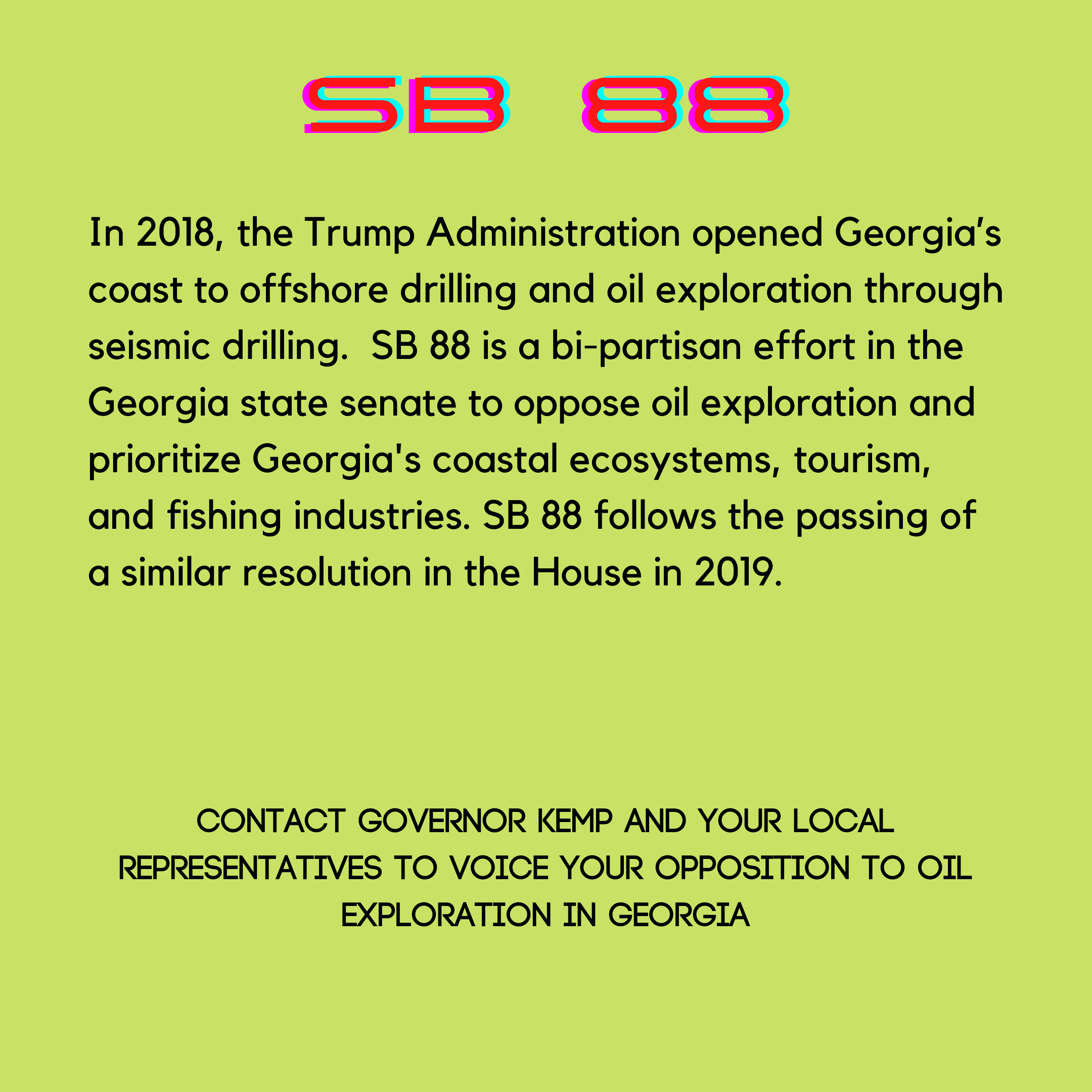
In 2018, the Trump Administration opened Georgia’s coast to offshore drilling and oil exploration through seismic drilling. This resolution is a bi-partisan opposition to oppose this exploration for oil here in Georgia and instead maintain our coastal ecosystems and support coastal tourism and fishing industries. It is following the passing of a similar resolution in the House in 2019. The bill did not come up for a vote this session but Georgia Conservancy supports this bill and hopes to work with legislators to reintroduce it in the next session.
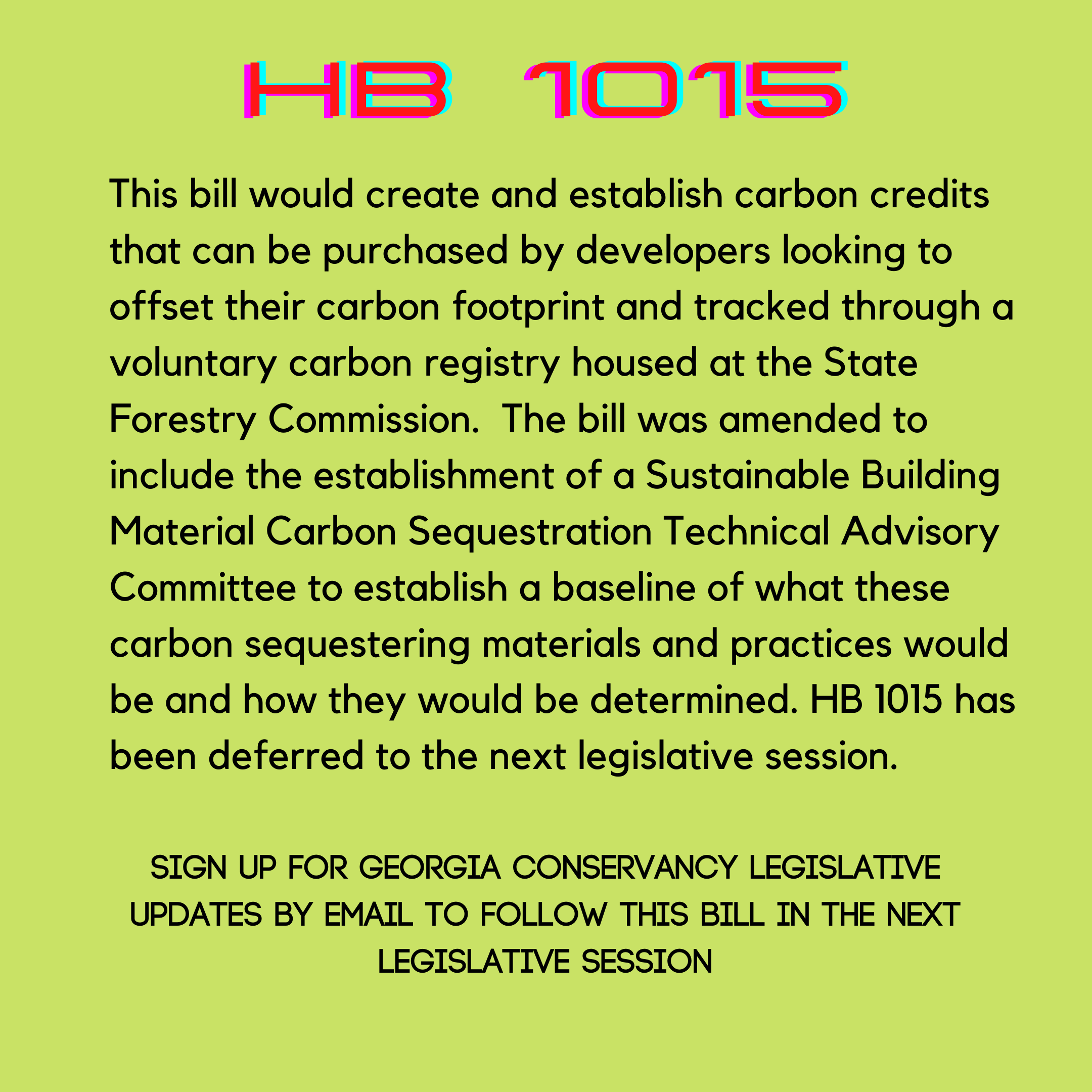
This bill would create and establish carbon credits that can be purchased by developers looking to offset their carbon footprint. This would be tracked through a carbon registry housed at the State Forestry Commission. The bill was amended to include the establishment of a Sustainable Building Material Carbon Sequestration Technical Advisory Committee to establish a baseline of what these carbon sequestering materials and practices would be and how they would be determined. Participation in the registry is voluntary for companies. HB 1015 has been deferred to the next legislative session.
Greetings ATLiens! This week our #motivationmonday feature is local chef and locavore expert, Julia Schneider! You may recognize her if you ever frequented (pre-COVID) the Ponce City Market Farmers Market by CFM where she has been a featured Chef. She is a private chef and also works with Moveable Feast ATL, a local catering company. COVID of course has her changing gears a bit and these days her Instagram is filled with all kinds of mouthwatering baked goods and other treats.
Originally from Michigan, she grew up cooking mostly Eastern European food with her adoptive grandmother, though her parents avidly grew food they were not very into cooking. She didn’t enroll in culinary school until her move to the ATL in 2009, but even then found that the best training was directly from the industry itself and moved on to start working with Octane in 2010. She was in charge of the food at all their locations and eventually their catering. In 2017, she began working with CFM as a Market Chef and doing private chef work. Her favorite part about working and living in Atlanta is the community. She connected with the founders of her current venture, Moveable Feast ATL, through work contacts that are also dear friends. She finds the strong locavore community and access to incredible locally sourced food in ATL to be one of the gems of this city.
As a chef diving into at home quarantine baking projects, Julia is not just a chef, she also represents a consumer in this climate conscious world. Julia says that climate is always something she is conscious of when preparing food for private clients or doing things at home. In her own kitchen she makes sure to use reusable containers, source from as many local farms as possible, and use as much of the ingredients as possible, including cooking with scraps. Some of her favorite places to source local ingredients are:
Freedom Farmers Market
Woodland Gardens Veggie Box
Georgia Organics Veggie Box with pick ups at Wrecking Bar
Freewheel Farms online pre-order
Levity Farms online ordering and pickup (both in town and in Roswell pickups available)
Chop Shop
Evergreen Butcher and Baker
Her call to action for ATL’s Green Foodies? It is way easier to eat local than you might think it is. Her advice is to take advantage of the Georgia summer fruits, if you peep her instagram @parkmeejung you will see delicious strawberry poptarts and pies.
End up with a bunch of random local foraged veggies like mushrooms and greens? Keep it simple! A big bowl of pasta, butter (or olive oil to keep it vegan friendly) and a little lemon juice. Let the veggies do their thing. Julia believes cooking for people is a way to show love and friendship, so until we can all get back out and safely enjoy market taste tests again- follow along with her and get some inspiration on how you can bring local food to those you love!
Meredith is GreenATLiens’ Foodie ATLien writing and reporting on all things sustainable food systems in Atlanta. She is an actor and a low-waster transplant originally from Cincinnati, OH. She will likely talk your ear off about locally grown food, carbon emissions, or animal welfare. But when she is not, she can be found hiking with her dog, kayaking, or riding her horse. Her latest obsession is the connection between growing your own food and the rich fertilizer that is manure. In short, she’s trying to grow tomatoes out of horse poop. She also does stand up comedy.
Unpopular opinion- I hate fireworks. There, I said it. I’ve never liked them, when I was little I could never get over the giant booms and the overall thought that the sky must be falling. Everyone around me would say, “but look at the pretty colors!” … to which I wish I would have responded, “Oh wow, gee, thanks for reminding me, totally didn’t notice how pretty it was while fearing for my life.”
So maybe I am a buzzkill but I think many of you following us here at GreenATLiens agree that this year’s Independence Day amidst the headlines of police brutality, climate injustice, global pandemic, and children in cages is cause for pause, or maybe a full stop. This year as we reflect on all that it means to be “American” and celebrate our “Independence Day” (read: the independence of slave-holding, misogynistic white men), I say we also take some time to understand that the “celebrating America by blowing things up” idea has pretty devastating impacts to our environment and biodiversity surrounding us.
The above graphic, created by Andy Brunning in The Chemistry of Firework Pollution for Compound Chem, clearly breaks down the chemicals used to create this explosive artwork, and how those chemicals and other materials can have negative effects on the world around us.
According to Terrapass, there are ways to make your annual fireworks displays a little more eco-friendly, even making them completely carbon neutral through the purchase of carbon offsets. The New Year’s Eve Firework display in Sydney, Australia has achieved total carbon neutrality by encouraging public transit, recycling leftover waste, and purchasing carbon offsets to balance out the pollution left in the air.
But what about noise pollution? The devastating effects fireworks have on local wildlife? The danger for wildfires in those habitats from shoddy at home firework displays? The use of fireworks has been known to cause serious disturbance in the habitats of birds, small vertebrates, invertebrates and mammals. The possibility of resulting brush fires, even ones that are small and easily contained, still destroy the living spaces of many of these creatures and their established eco-systems. The fear and panic caused by loud noises can cause birds and mammals to leave their nests and become disoriented and unable to return, leaving their young unprotected (source).
We can see evidence of this in our own domesticated animals. Fireworks have a very high decibel level in the boom, as much as 190 decibels, more than a gunshot or even some jet engines. We know that many animals, including dogs and cats have a much more sensitive sense of hearing than humans, meaning they are at much greater risk for hearing loss or tinnitus from firework sounds (source). And additionally, many animal welfare professionals will tell you that July 5th is one of their busiest days of the year when it comes to stray animals. If you follow any of our local animal welfare organizations here in Atlanta, you will have seen their posts recommending that you keep your dogs and cats inside. Firework noise, summer storms, and other factors all contribute to a higher level of stray animal intake throughout the summer, which reaches a maximum around this time. Here you can find a list of helpful tips to keep your pets safe and prevent them from getting lost around this time. Because of the higher amounts of animals needing care in shelters at this time of year, many shelters are operating at or over capacity and are offering low-cost adoption events or promoting fostering.
So, all I am saying is, maybe this year you mix up your usual Fourth of July celebrations. Foster a dog or cat, go for a nice walk to observe your local biodiversity, or watch Hamilton! And if you really need a little flair, go outside with some sparklers, just make sure you properly dispose of all the pieces!
Meredith is GreenATLiens’ Foodie ATLien writing and reporting on all things sustainable food systems in Atlanta. She is an actor and a low-waster transplant originally from Cincinnati, OH. She will likely talk your ear off about locally grown food, carbon emissions, or animal welfare. But when she is not, she can be found hiking with her dog, kayaking, or riding her horse. Her latest obsession is the connection between growing your own food and the rich fertilizer that is manure. In short, she’s trying to grow tomatoes out of horse poop. She also does stand up comedy.
After the recent whirlwind of police killings of victims George Floyd in Minneapolis, MO, Breonna Taylor in Louisville, KY, and Rayshard Brooks in Atlanta, GA, there has been an increasing call from the people to defund police departments that have been the perpetrators of brutality, violence, and murder against black people for centuries in the United States.
The people of Atlanta have mobilized numerous times to march and demonstrate in downtown Atlanta and beyond to defund the police, stop police brutality, end voter suppression, and dismantle the prison industrial complex. Especially considering that Rayshard Brooks was the 48th police shooting the Georgia Bureau of Investigation investigated in 2020 (Mainline Zine). In response to rising public sentiment to defund APD, Mayor Bottoms met with and Atlanta City Council June 15th to respond to public calls to revise the budget. Essentially, the amendment to defund APD by 50% was shot down and members of City Council -most vocally Antonio Brown of District 3 where Rayshard Brooks was killed by APD – have been calling on constituents to call into virtual City Council meetings to demand the City defund APD by 33% or 73 million to reimagine safety. In reimagining safety Brown is possibly subtly referencing a viral infographic that was circulating on social media:
Infographic from KnowYourMeme.Com
Since the 2021 Atlanta City Budget has remained unchanged, we at GreenATLiens thought you’d might like to know a few things that got defunded in order to increase the APD budget by over $12 million.
What did the City of Atlanta defund for 2021?
Please keep in mind this is not an exhaustive list. The full PDF of the 2021 Atlanta City Budget can be found here. GreenATLiens is also interested in examining how these particular instances of defunding not only harm the environment but also harm the black community, or in other words are concrete examples of systemic environmental racism.
Department of Public Works defunded from $51.7 million in 2020 to $0 in 2021. Public Works is responsible for maintaining infrastructure, so if there’s any broken bridges or crumbling historic buildings they’ll have to apply for a grant or rely on community donations to fund infrastructural renovations.
Built environment is an incredibly valuable aspect of sustainability. Preserving buildings and infrastructure helps us make things last for as long as possible and reduce the use of new resources. Built environment preservation helps reduce activity that contributes to climate change, essentially.
Defunding the Department of Public Works also disadvantages predominantly black neighborhoods in Atlanta, particularly Historic West End with historic buildings in need of renovation. The Atlanta Budget is essentially saying “You won’t get a cent from us, go have a fish fry to raise the funds cuz we ain’t helpin’.” The budget for Public Works in 2021 is literally $0! *Rubs eyes* Yep, still $0!
2. Department of Parks and Rec is being defunded by $1.6 million (2.4%) in 2021. Not only that but they’ll also lose 33 personnel (see below or budget page 70).
Parks as green spaces naturally are beneficial to the environment, specifically as urban wildlife habitats, carbon sequestration in the form of trees, water pollution reduction through plants that retain and prevent stormwater runoff that carries toxins into storm drains and ultimately our drinking water.
Parks are also highly important for maintaining public health. They provide a community green space to run, jog, play sports, or otherwise exercise, as well as improve one’s mental health through nature therapy and release of endorphins from physical activity and sun exposure. Defunding Parks and Rec means that communities lacking access to greenspaces are less likely to see any park development in the coming year. Wait, the budget says.
Screenshot of the Atlanta City Budget’s summary of personnel showing that APD will have an increase in personnel of 229, while Parks and Rec will lose 33 personnel, Watershed Management will lose 25, Human Resources will lose 9 and Department of Audit will lose 2.
3. The budget literally defunded justice. Atlanta’s Judicial Agencies got a 2.74% budget cut of $367K, so judges will be more overrun with cases than before. If you believe the Criminal Justice System and Prison Industrial Complex can be reformed, then defunding the courts that give Atlantans trials is a blow to justice and a disservice to the people.
Filling up prisons with black people for offenses white people get off easy for is another example of environmental racism. It keeps people out of the workforce and out of the voting pool to suppress black voters and keep black families economically destabilized without two members of household to contribute to household income and the work of running a household. Holding people in cages and forcing them to perform unpaid labor while leaving their families to fend for themselves is a modern form of slavery and oppression. A fair and non-corrupt justice system would end this continued disservice to Atlantans.
4. The Department of City Planning was defunded by $1.6 million (7.33%). Defunding City Planning means defunding walkability and bikability in Atlanta. Defunding City Planning is an example of systemic environmental racism and here’s why:
Poor urban mobility, meaning a poor ability to get around without full dependence on a car, is a systemic factor that makes it more challenging for low-income communities to get around to places like a job, the DMV, a poll location, or the grocery store. It’s essentially a way of keeping wealth in the communities that have wealth and denying low-income communities access to that wealth. Additionally, for those who do decide to walk or bike to access opportunities and needs, doing so poses a greater threat to one’s life than on, say, the cushy BeltLine or Freedom Park Trail.
Poor urban mobility reinforces poverty, car dependency, air pollution, and carbon emissions that contribute to climate change. Not to mention the effects of a car-dependent lifestyle on physical health. Car dependency also puts a financial burden on and further economically destabilizes low income households. This is why City Planning needs a budget increase and not a budget cut to improve urban mobility across all of Atlanta and particularly low income areas. Improved urban mobility and diminished car dependence reduces the city’s footprint and air pollution while also connecting communities to more opportunities. With reduced air pollution we’re likely to see less asthma-related hospitalizations and deaths, which disproportionately affect black and brown communities.
5. Water was defunded. The Water and Wastewater Revenue Fund is scheduled to be defunded in 2021 by $23 million (3.9%). The Department of Watershed Management is also scheduled to lose 25 personnel next year while APD adds on 229. Despite Atlanta’s innumerable water woes, Atlanta’s water received the second largest budget cut after the Department of Public Works. Perhaps they’ll pass the buck to non-profit organizations Chattahoochee Riverkeeper and Westside Water Alliance (WaWa) to keep our drinking water clean. Why spend government budget money on clean water when we can have these non-profit organizations apply for unreliable grant funding and rally their supporters to give out of the kindness of their hearts for our basic human right to clean water?
Cancerous toxins in our drinking water is an environmental health issue that quite literally, albeit slowly, kills the poor and disproportionately affects black and brown communities that have been systemically kept from accumulating wealth. Defunding water is defunding black lives, and defunding environmental health across the board for all Atlantans.
What can you do?
District 3 Council Member Antonio Brown is calling on all residents of Atlanta to:
“call in to every committee and full council meeting to demand we amend the budget and fund the resolution approved by council today. Reallocate $73M of police funds in order to reimagine public safety. We must stop the business of the city from moving forward until our demands are met.”
If you can’t attend the meeting due to work be sure to leave a voicemail write a message to your Councilmember and the general City Council email atlantacouncil@atlantaga.gov.
Sharing personally how defunding these various areas of the city budget to increase funding and personnel for APD affects you or a loved one will be the most impactful. Here are a few prompts to get you started:
Is there infrastructure near you that won’t get the attention it deserves as a result of cuts to Public Works?
Is there a lack of community greenspace where you live, or community greenspace that needs investment to be properly maintained? In that case why is Parks and Rec being defunded and scheduled for lay-offs when these greenspaces are of growing importance to the physical and mental health of our communities? If there’s a lack of greenspace where you live, how far would one have to walk to the nearest greenspace? Is it a safe walking distance for children?
Have you or a family member been incarcerated? How did that affect your family economically, emotionally? Do you think defunding the Atlanta’s judicial agencies is in the interest of justice for the people of Atlanta?
Do you walk, bike, or take public transit for transportation? Or would you like to? Tell City Council that cuts to City Planning hurts urban mobility in Atlanta and in turn dampens economic opportunity, reinforces income inequality, and increases car dependency that’s shown to be so detrimental to environmental health as well as public health.
Do you drink water? Would you like Atlanta’s water to be safe to drink for all Atlantans? Don’t you think instead of defunding the Department of Watershed by $23 million (meanwhile increasing APD’s budget by over $12 million) we should be increasing investment in clean water for all?
That’s all for now. Please feel free to add your comments, we’d love to hear your thoughts. Stay green, ATLiens!
Happy #MotivationMonday GreenATLiens! Today we’re feeling motivated by the demonstrators who used their First Amendment rights today at the March On Georgia organized by the NAACP of Atlanta.
It was GreenATLiens’ privilege to chat with a few of the demonstrators present today. Below are direct quotes from March on Georgia demonstrators on their recommended calls to action for all ATLiens:
“Reparations now! Police reform immediately. Mandatory punishment for failure to use body cams. [Prosecute] police for hate crimes. Shoot below the waist. [Use non-lethal] rubber bullets.”
Feeling motivated yet? If you find inspiration through music might we suggest Spotify’s Liberation Playlist or Black to the Future Playlist? Let’s take that energy and apply it to making real, sustainable change for a more just and equitable society!
March on Georgia this Monday, 9:00AM at the Richard Russel Federal Buildong 75 Spring St SW. Don’t forget your masks, signs, and energy!
There is no sustainability in Georgia’s future without repealing citizen’s attest, criminal legal reform, restoring voting rights, and ending police brutality.
Greetings ATLiens 🖖 This #MotivationMonday in observance of #WorldOceansDay we would like to meet Dr. Brian Davis, President and CEO of the Georgia Aquarium. Originally from New Jersey, Dr. Davis earned his B.S. in Environmental Science at Rutgers University in 1992 and shortly thereafter migrated to Atlanta for a position at Zoo Atlanta. The rest is history.
Since moving to Atlanta 26 years ago, Dr. Davis has paid his dues teaching science for over 8 cumulative years in Cobb County schools, serving in senior leadership roles within a number of zoological and educational institutions, and earning his Masters of Education and Ph.D. in Secondary Science Education at Georgia State University. What you may not know about Dr. Davis is that he’s played an integral role in shaping the Georgia Aquarium’s educational programming since 2003.
If you take just one thing away from today’s #WorldOceansDay #MotivationMonday, let it be that Dr. Brian Davis has been working on and advocating for ocean conservation way before most of us were even cognizant of the impacts of plastic in our oceans.
Dr. Brian Davis states:
“I believe scientific literacy and a comprehensive cultural enrichment plan are vital to the continued progress of our students and society. In my current role as President and CEO of the Maritime Aquarium, I will continue my efforts to develop educational experiences that reflect the interconnectedness of scientific literacy to our daily lives.”
Source: Dr. Brian L. Davis (LinkedIn bio)
As President and CEO of the Georgia Aquarium, Dr. Brian Davis oversees the Georgia Aquarium’s research, animal rehabilitation, and education initiatives, including the Seafood Savvy campaign aimed at educating the public on the types of seafood to avoid in the interest of ocean conservation (see wallet insert here, and below), as well as the ongoing expansion of strategic partnerships with local and global organizations to fundraise, research, and promote ocean ecosystems conservation.
Call to Action
GreenATLiens everywhere can join Dr. Brian Davis in taking action for our oceans by practicing the 3 R’s: Reduce Reuse Recycle. See the quote below for more nuance:
“Remember to cut apart plastic beverage rings. Marine mammals can become entangled in the loops, which can be harmful and potentially fatal. Properly dispose of toxic wastes, such as oil from automobile engines or lawnmowers. Never dump waste chemicals down a sewer which can pollute water sources. Limit your use of disposable products, particularly plastic. Take a canvas bag with you when you shop instead of using paper and plastic ones from stores.”
Last Friday our spaceship landed at Centennial Olympic Park for a march to the Georgia State Capitol to demand justice for George Floyd, Breonna Taylor, Ahmaud Arbery, and so many other black lives that have been taken by police and white supremacists in this country for centuries.
The protest we participated in on Friday, May 29 was a large gathering of peaceful protesters holding cardboard signs with messages such as “Stop Killing Us,” “Black Lives Matter,” “White Silence is Violence,” and “I Can’t Breathe”. For what seemed like the majority of the march, hundreds of Atlantans marched in complete silence holding signs of cardboard over their heads. As we neared the Georgia State Capitol, marchers began to chant “No Justice (No Peace)” “Black Lives Matter,” “What Do We Want? (Justice) When do we Want it? (Now),” and “When Black Lives Are Under Attack, What Do We Do? (Stand Up Fight Back)”.
Once the crowd reached the Capitol, many people dispersed by way of Uber/Lyft, MARTA, their bicycles, etc. Only when our space ship arrived back home did the majority of protesters hear about apparent vandalism that took place, which the Mayor, T.I., Killer Mike, and others addressed in a press conference that evening.
While many weaponize quotes from Martin Luther King Jr. to condemn rioting and promote peaceful protest, it is important that we remember Dr. King’s less-cited quote:
A riot is the language of the unheard
-Martin Luther King Jr.
The infographic below sheds further light on the nature of what happened Friday night in Atlanta.
Source: @drew_droege
Couldn’t have said it better ourselves.
What is the connection between environmentalism and racial justice?
Here are a few suggested readings to better understand how racial justice and environmentalism are inextricably linked:




 Green ATLiens